 由 jingzhang

According to the latest news as of early Wednesday, Amazon has sent a cease-and-desist letter to the AI search startup Perplexity, demanding that it prohibit its AI browser, Comet, from shopping on behalf of users on Amazon’s online marketplace .
In the letter, Amazon accused Perplexity’s AI agent of employing deceptive means while shopping for users, thereby violating the website’s terms of service . Amazon also alleged that Perplexity’s AI tool degrades the Amazon shopping experience and introduces potential privacy vulnerabilities .
As background, Amazon’s marketplace terms of service prohibit “the use of any data mining, robots, or similar data gathering and extraction tools” . In November 2024, Amazon had requested that Perplexity not deploy AI agents capable of shopping on its website until a mutual agreement was reached, to which Perplexity agreed and complied at the time .
According to insiders, when Perplexity launched its AI browser named Comet this summer, these agents were disguised as “Google Chrome browser users” . Amazon stated in its letter that as Perplexity refused to stop this behavior, it attempted technical blocks, but Perplexity then released a new version of Comet that bypassed these measures .
Amazon’s Stance
Amazon spokesperson Lara Hendrickson stated in a declaration: “We believe that when third-party apps make purchases for customers on other platforms, they should operate openly and transparently and respect the decision of the service provider on whether to participate” .
She added that other companies, including food delivery platforms and online travel agencies, operate in the same manner .
This conflict provides an early preview of the evolving “AI-era commerce war”: how major and minor internet platforms will respond to third-party AI tools operating on their turf .
Taking Amazon itself as an example, the company is also training its own AI agents, offering functions like recommending products and placing orders for consumers .
From a commercial perspective, third-party AI agents pose a direct threat to Amazon’s highly profitable advertising business, which primarily earns revenue by selling prominent placement for product search keywords . If external robots represent customers in shopping, sellers’ advertisements become worthless .
Perplexity’s Response
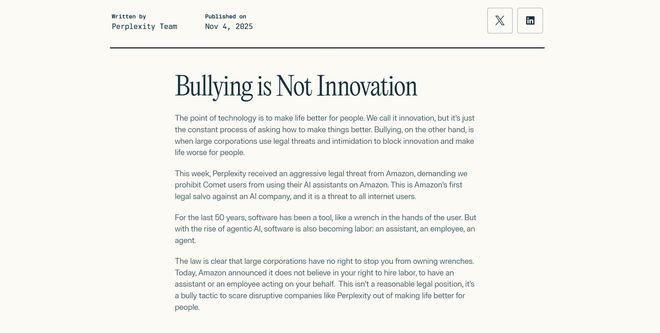
In response to Amazon’s eviction notice, Perplexity promptly published an open letter titled “Bullying Is Not Innovation” .
This AI startup, valued at over $20 billion, stated that Amazon is suppressing a competitor in the AI agent space and asserted that users should have the right to choose their preferred agent for shopping on Amazon . The startup wrote: “This is a typical bullying tactic aimed at intimidating disruptive companies like Perplexity that are trying to improve people’s lives” .
Addressing Amazon’s accusation of “disguising AI agents,” Perplexity CEO Aravind Srinivas responded that he sees no need to distinguish between users and the AI agents authorized to act on their behalf . He argued that AI agents should enjoy “the exact same rights and responsibilities as real human users,” and more importantly, “this is not something Amazon should scrutinize” .
Interestingly, amidst the interconnected “AI ecosystem” in the US tech circle, Perplexity and Amazon have a close relationship . Srinivas mentioned that his company has placed hundreds of millions of dollars in orders with Amazon Web Services (AWS), and he himself has publicly appeared at AWS events . Furthermore, Amazon founder Jeff Bezos is also an investor in Perplexity .
Separate leading indicators from financial outcomes
Usage, retention and pipeline often move before recognized revenue or cash. A useful dashboard combines these leading signals with financial results so management can distinguish a temporary accounting lag from a real deterioration in demand.
Definitions should remain stable enough that teams do not change the metric when performance becomes inconvenient.
Document assumptions beside the forecast
Model outputs are only as reliable as their assumptions about pricing, conversion, cost and timing. Keeping those assumptions visible makes scenario analysis faster and reduces false precision.
Review the model when product behavior changes
New modalities, pricing plans or sales motions can invalidate old averages. Finance models should evolve with the product rather than forcing new behavior into outdated categories.
Measure the full contribution margin
Gross revenue can hide payment fees, AI serving cost, creator share and support burden. Contribution margin is more useful for deciding whether growth is creating economic value.
Segment the calculation by product or customer type because one blended percentage can conceal weak economics in a fast-growing area.
Use scenario analysis for uncertain inputs
AI businesses face volatile usage and infrastructure cost. Base, upside and downside cases help management see which assumptions matter most and where protective actions are available.
Reconcile forecast with actual drivers monthly
Instead of only comparing total spend or revenue, explain how much variance came from volume, price, mix and unit cost. This turns the forecast into a learning system for the business.
 admin